Coming
Soon
Sikhism
The
Sikh Philosophy
The
Sikh Gurus
Guru
Nanak
|
| In the 15th century
'Sikhism' as a religious way with its own philosophy emerged.
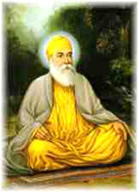
Guru Nanak the founder was a Guru with household and family. Born
in 1469, Guru Nanak believed fully, in the devotional path towards
God. He never renunciated life and preached that every normal
person irrespective of age or caste is entitled to recite, rehearse
the god's name which is the only way for the welfare of the society.
Soon after his teachings got a wide acceptance, his followers
got united and 'Sikhism', a sect emerged. It did not differentiate
between Hindus and Muslims. |
 |
Guru
Nanak made a continuous, rigorous pilgrimage throughout Bharat and abroad.
He was trying to absorb the contemporary socio-political situation,
which only confirmed his views about life. This pilgrimage converted
him from a 'seeker' to the 'enlightened' status. Lately after this entourage
for around 15 years, he settled himself at Kartarpur- on the West Bank
of Raavi River. He led quite a peaceful but regulated life here and
met people from all walks of life. After his passing away in 1538 both,
his devotees from Hindus and Muslims compromised and led him in peace
as per his wishes. In his last days he had nominated his enlightened
disciple 'Angad' as a Guru. Consequently the Sikh sect had 11 prominent
Gurus. Each of them has a unique contribution towards the religion.
He
sacred book of the Sikh religion is 'Grantha Sahib'. This is slightly
different from the other religious books in the sense that, it has taken
the verses of other eminent saints like Kabir, Ramanand, Namadeo- the
leading personalities in the devotional ( Bhakti) aspect. This volume,
to facilitate reading by the common, grassroots people is written in
the local script. This script was later named as 'Gurumukhi'- to indicate
the Guru is using it.
It is very interesting to know how an original Bhakti sect, with
the passage of time got transformed as the most vehement and militant
religious sect.
 |
Owing to its strategic location
the Punjab provinces always had to face enormous invasions, which
continued till the end of Mughal era. Probably dwellers there
as a result were bound to emerge with a militant philosophy. But
then from Guru Nanak, till the fourth Guru Ramadas, Sikhs lived
in harmony with the rulers. The fourth Guru Ramadas had met the
Mughal emperor, Akbar, in 1574. It was Akbar who gave him a spacious
land on which Ramadas and his disciples built a beautiful lake
and a temple. This is the golden temple of Amritsar. The clash
with the rulers first took place, during the period of Jahangir
and Sikh Guru Arjun Dev. |
Jahangir's
son, Khusru had revolted against him and Arjun just happened to give
him a shelter for a while. This annoyed Jahangir and he killed Arjuna,
this incidence created havoc amongst the Jat followers of Sikhism. And
they got together to defend the injustice. Since then events after events
confirmed that the Mughals in no way can be friends of Sikhs. The sixth
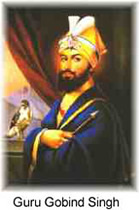
Guru, Gobind actually transformed the sect as a militant and warrior
self-defending sect. Gobind instigated the feeling of bravery and discipline
in the Sikhs. Each of his chosen Sikhs was all time required to possess
5 k's (kakars) with them. Those were, Kesh (grow hair), Katch ( a tight
inner wear), Kangi ( a comb), Kada (a bracelet) and Katyar ( a sword).
He started affixing 'Singh' (lion) before the name of each of his chosen
militants. The first chosen five were known as the favorite fives. (
the Panch Pyare) and their organization was named 'Khalsa'- meaning
pure, in Arabic.
During Shehajahan's time Punjab was rocked by numerous clashes
of Sikhs with the Mughals. Such incidents turned each of the Sikh Gurus
more to Senapatis (militant officers). Strangely enough during the Khalsa
time most of the cities of Punjab were developing and flourishing. Lahore,
for example was the capital.
Slightly turning away from the new, militant attitude of Sikhism, Sufi
sect emerged. The great unity in thoughts and daily life was responsible
that the Khalsa spirit not only survived but emerged as strong power
center despite so many clashes, battles, massacres of Sikhs.
Till the early years of 1800, the Sikh power flourished and the Sikh
empire spread it's wings from Punjab to Kashmir wiping put the Mughal
rule in these areas. Sikhs had a systematized system of donating money,
for the sect. There were small and large divisions. The larger ones
known as 'misals' . these misals were substituting a single Guru and
were the Sikh governance. It was through one such 'misal', that Ranajitsingh
could fast achieve the ladder of power. Once he rose, soon he attached
Kangra valley and the southern area of Sutlej banks till Jhelum to his
kingdom.
In 1813 he attacked Kashmir and obtained the famous 'Kohinoor' diamond
from Shaha Suja-the warden of Mughals.
However in the later years, the British rulers were afraid of the Napolean's
possible attack in Bharatiya territory. To defend him, they needed Ranajit
Singh and made a tryst with him.
Later part of the Sikh sect generally goes hand in hand with the British
rule and by 1854, they were possibly, the best friends of the British
rulers.
©
2001 vandemataram.com All rights reserved
|
 |