Coming
Soon
Shivaji
& his earlier life
His
Policy towards other kings
Successor
of Shivaji
|
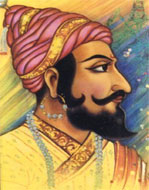 |
A significant change , in the history
of Bharat , is seen from the times when Emperor Shivaji rose to
power. That is , the trend that always the invaders , for past
few years proved to be the winners on battle field, consistently
got defeated by the Maratha's Shivaji was born on April 10th ,
1627. The reason being, definite motives and goals, set by Shri
Shivaji right from his childhood. He was witnessing the unrest
caused by the various Mohammedan powers surrounding his territory
by & large Maharashtra. He had powerful influences of the
teachings of his earlier Guru |
( teacher ). Dadoji Kondadev, and his mother Jijabai. His early conquests
of fort Torna and near by territories, coupled with great diplomacy,
to avoid direct war with Adilshahs & Mughals are charming &
inspiring. He had the right personal and military & administrative
capabilities to rule, as an emperor, a territory. He was always non-communal
& justice loving. During his times, he suffered, which he turned
strategically to future opportunities.
Even when he was in total captivity at Agra, along with his
son Sambhaji, at Aurangzeb's fingertips, his valor made an impossible
escape possible - from Agra, he flew way down to Raigad in Maharashtra,
in a disguise. There after,
he decided to consolidate his empire. Morally what was needed for
the Indians & Hindus was presence of an solemn emperor, and an
empire, which they could call their own. Recognising this need, Shivaji
got himself coronated at his new, carefully built capital Raigad
at the hands of Gagabhatt, a vedic Pandit from Kashi.
His coronation, overwhelmed the Hindus - now they had an sovereign
state of their own. The event,
however sent shock waves through the Mughal &other Mohammedan
dynasties. This was an open challenge to their presence, a solemn
declaration of the law
of Hindu land a direct threat to their atrocities. More fearful for
them was presence of British and Portuguese ambassadors at the coronation
and their offering of valuable gifts as the acceptance.
From
Ramnagar in north, till Karwar in South lay Chatrapati Shivaji's
empire. On the east the kingdom spread from Baglana and large
part of Kolhapur district. He had definite policies and administration
. He had various land reforms, a definite agricultural tax structure,
a well knit army with a hierarchy and very importantly a fleet of Navy,
to guard the coastal waters of his empire. He had an Eight fold ministry,
( the Ashtapradhan Mandal ) with concerted responsibilities laid to each minister. He was
always, in his mind preparing for a ultimate deciding battle with Aurangzeb.
However time didn't permit him the same, and in 1680, he passed away
leaving behind him a well- knit empire. His son , Sambhaji Raje was
equally brave. However, he couldn't nurture
the dream of his father. Although he maintained the status of
the empire for a while, his lack of total concentration on the governance,
his fiery temper, his inability to keep various people together ultimately
deceased glory of the Maratha empire. In any case, from the military
view point he was 'the' tiger's cub , who fought five fronts simaltanously.
Portuguese, Mughuls, Britishers, his own defectors, & Adilshahi
. Equally romantic and inspiring, is his death a tortured one at the
hands of Aurangzeb. Till his last breath, he denied getting converted
to Islam. In Maratha history he will always be remembered, as one of
the most worshipped martyrs who laid for their cause and the nation.
After
Sambhji's time the successor's of Shivaji were Rajaram his second son,
and Shahu, the son of Sambhji. Although the
Maratha empire never could attain the glory of Shivaji's time
they never allowed themselves, to be taken over & defeated by the
Moghuls. True to Shivaji's vision, Aurangzeb did invade in South to
abolish Maratha empire in
total . Never did he succeed in this aim, and had to meet a pitiable
death near Aurangabad in Maharashtra . It was the Maratha empire which
survived with the only change that center of power then onwards was
the Peshwa rule.
©
2001 Vandemataram.com All rights reserved.
|
 |